No-Code Builders vs n8n: When a Visual Automation Tool Beats a Pure Agent Builder
No-code agent builders ship a working assistant in an hour — until your requirements outgrow the guided flow. Where the line sits between a pure no-code builder, a flexible tool like n8n, and a code-first framework.
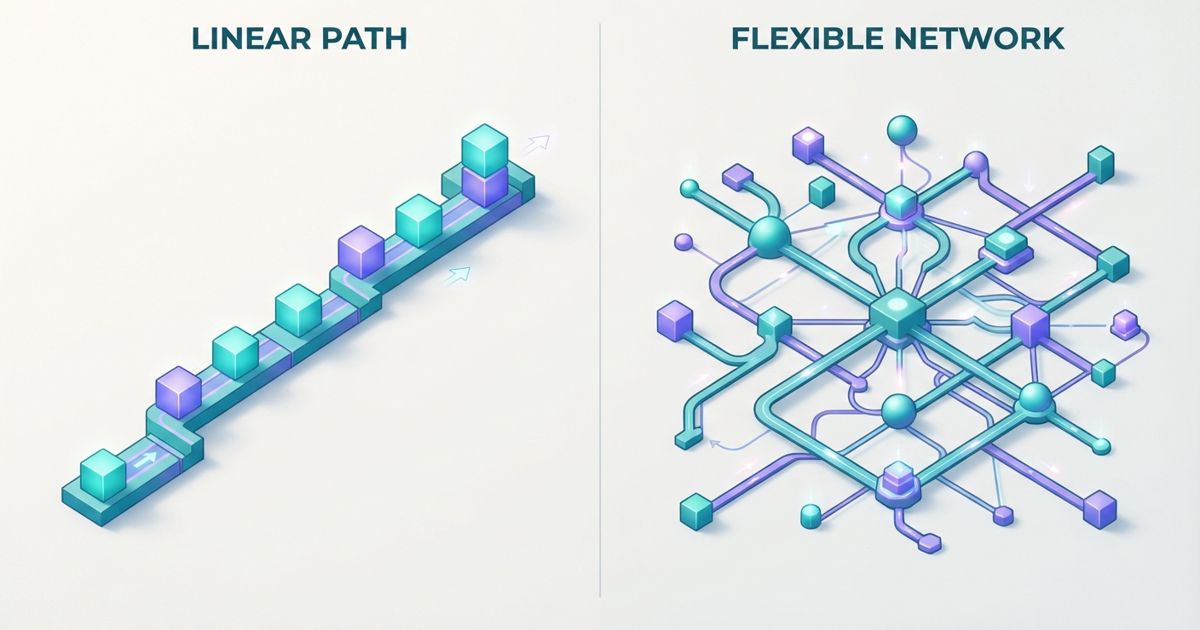
Table of contents
The no-code agent-builder space has exploded. You can now describe what you want in plain language, click through a guided flow, and have a working AI assistant in an hour — no developer required. For a lot of use cases that is genuinely enough, and we have said so before in our look at no-code AI agent builders. But there is a predictable moment in almost every serious project where the guided builder starts fighting you, and a more flexible tool like n8n starts to make sense.
Knowing where that line sits saves you from both mistakes: over-engineering a simple bot, and boxing a complex one into a tool it will outgrow.
What pure no-code builders do well
Dedicated no-code agent builders optimize for one thing: getting a non-developer to a working agent as fast as possible. They give you a chat-first interface, prebuilt templates, managed hosting, and a narrow, opinionated set of choices so you cannot get lost. For an FAQ bot, a lead-qualification assistant, or a support agent working from a knowledge base, that focus is a feature, not a limitation. You should not reach for a heavier tool when a purpose-built one ships the result in an afternoon.
The trade-off is that the same guardrails that make them fast also cap what they can do. The moment your requirements step outside the builder's happy path, you feel the walls.
Where n8n pulls ahead
n8n is an open-source, fair-code workflow-automation tool with a node-based visual editor. It is less "describe your bot and go" and more "wire up exactly the flow you need." That extra effort buys capabilities that pure no-code builders usually cannot match.
Code nodes for real logic. When a workflow needs a transformation, calculation, or bit of logic the visual blocks do not cover, n8n lets you drop into JavaScript or Python right inside the flow. You stay no-code until the exact point you need code, then step out — without abandoning the platform. Most locked-down builders give you no such escape hatch.
Connect to anything. With 400+ integrations plus a raw HTTP request node, n8n reaches internal APIs, niche services, and legacy systems a closed builder will never support. If it has an endpoint, you can call it.
Self-hosting and data control. You can run n8n on your own infrastructure with Docker, keeping sensitive data inside your compliance boundary and avoiding per-task billing — or use the managed n8n Cloud. That ownership option simply does not exist with most SaaS-only agent builders. It is the same self-host-versus-managed calculus teams weigh when running AI agents on their own VPS.
If you want to feel that flexibility without standing up a server, the managed tier is the low-friction way to start: Try n8n.
It still builds agents — with the whole workflow around them
This is the part people miss: n8n is not only a workflow tool bolted next to your AI. It has AI Agent and LangChain-style nodes, works with essentially any LLM, and supports RAG out of the box. So you get agent-building and the full automation surface — webhooks, schedules, branching, error handling, hundreds of connectors — on one canvas.
That combination matters because a real agent is rarely just a conversation. It has to fetch data before it answers, write results somewhere after, notify a human on edge cases, and retry when a call fails. A chat-only builder handles the conversation; n8n handles the conversation and everything around it. If you are still mapping what an agent even is versus a plain chatbot, our explainer on what an AI agent is sets the baseline.
When a code-first framework beats both
To keep this honest: n8n is not the top of the flexibility ladder. For agents with highly dynamic, deeply recursive reasoning — where the control flow itself is the hard problem — a code-first framework gives you more precision than any visual tool. We compared the main options in LangGraph vs CrewAI vs AutoGen. n8n sits in the productive middle: more powerful and open than a locked no-code builder, more visual and faster to ship than raw framework code.
A simple way to choose
Match the tool to the job:
- Pure no-code builder — your agent is a bounded conversational assistant, your team has no developers, and speed to launch is everything. Do not overthink it.
- n8n — you need custom logic, integrations a closed builder lacks, data control or self-hosting, or an agent that orchestrates real work beyond chat. Use n8n Cloud for zero maintenance, or self-host if you want full ownership.
- Code-first framework — your agent's core challenge is complex, dynamic reasoning and your team can maintain code.
The bottom line
No-code builders are not inferior to n8n; they are optimized for a different point on the curve. The failure mode is using a builder that caps out on a project that was always going to need custom logic, or reaching for a flexible tool when a simple one would have shipped today. n8n earns its place the moment you need real extensibility, broad integration, or ownership of where your automation runs — without dropping all the way down to code. The best way to find your line is to rebuild your current agent in it and see how much further it goes: Try n8n free.